Blanking Announcement for Chinese National Holiday On Transpacific Services
Due to expected slow volume pick-up in connection with the upcoming Chinese National Holiday (Golden Week), Maersk endeavours to balance our network to match reduced demand in October. Below you will find a summary of void sailings on Transpacific services. We aim to minimize the impact to our customers by securing reliable alternative routings.
Please feel free to reach out to your local Maersk Customer Service representatives or check https://www.maersk.com/local-information and https://www.maersk.com/schedules/ for more details.
Far East Asia to North America

North America to Far East Asia


Eagle Express 1 Void Sailing
Please be informed of the following void sailing that will be implemented on our Asia-North America service in September due to scheduled vessel dry dock.
To minimize impact to our customers, alternative sailings are available for your cargo originally intended on the advised void sailing.

Contingency plan for EX1 – PRESIDENT WILSON
• Cargo from Shanghai / Yangtze area / Indonesia to load on vessel voyage CMA CGM ROSSINI (0TXSUE1MA) ETA Shanghai 23-SEP-2020
• Cargo from Qingdao / Lianyungang / Dalian / Xingang / Ningbo / Philippines / Japan / Korea to load on vessel voyage CMA CGM ROSSINI (0TXSUE1MA) ETA Busan 26-SEP-2020

2020 GOLDEN WEEK BLANK SAILINGS – ASIA-NORTH AMERICA NETWORK – UPDATE
The following announcement supersedes our announcement of 8 September 2020 about Asia-North America network blank sailings.
MSC Mediterranean Shipping Company plans to exclude sailings during Golden Week holiday on its Asia-North America Network due to the anticipated slowdown in demand during and after this period.
The change will help us to match capacity with the expected weaker market demand for shipping services. However, you may continue to place bookings as usual as we are arranging alternate routings.
Our blank sailing programme will start as from week 40 as per the below:
ASIA TO U.S. EAST COAST
WEEK 40 OMISSION
AMBERJACK service
Blanking voyage 1E, ETA Tianjin 01.10.2020 To and Via: Kingston, Savannah, Charleston, Jacksonville, Wilmington All shipments from Tianjin, Qingdao, Ningbo, Shanghai, Busan will be served via alternative services.
ASIA TO CANADA AND U.S. WEST COAST
WEEK 41 OMISSION
MAPLE service
Blanking voyage UM41N, ETA Nansha 09.10.2020 To and Via: Prince Rupert, Vancouver All shipments from Nansha, Yantian, Shanghai, Busan, Yokohama will be served via alternative services.
WEEK 43 OMISSION
SEQUOIA service
Blanking voyage US43N, ETA Yantian 20.10.2020 To and Via: Long Beach All shipments from Yantian, Ningbo will be served via alternative services.
U .S. EAST COAST TO ASIA
WEEK 45 OMISSION
AMBERJACK service
Blanking voyage 10W, ETA Savannah 04.11.2020 To and Via: Busan, Tianjin, Qingdao, Ningbo, Shanghai All shipments from Savannah, Charleston, Jacksonville, Wilmington, Kingston will be served via alternative services.
CANADA AND U.S. WEST COAST TO ASIA
WEEK 44 OMISSION
MAPLE service
Blanking voyage UM44S, ETA Prince Rupert 27.10.2020 To and Via: Nansha, Yantian, Shanghai, Busan, Yokohama All shipments from Prince Rupert, Vancouver will be served via alternative services.
WEEK 46 OMISSION
SEQUOIA service
Blanking voyage US46S, ETA Yantian 06.11.2020 To and Via: Yantian, Ningbo All shipments from Long Beach will be served via alternative services.

Golden Week Vessel Idling Program Trans-Pacific Service
(San Francisco, CA)…As a result of reduced demand due to Golden Week holiday we will adjust our network to match expected market demands. Below you will find a summary of void sailings:


In light of the above void sailings, the following return voyages will also be voided.


Commercial Invoice Requirements
Requirements of a commercial invoice, bill of sale, receipt that must be provided when filing entry documents for Customs clearance
A commercial invoice should contain enough information for a Customs Officer to determine if the goods being imported are admissible, and if so, the correct classification and valuation of goods. For further guidance, see the Harmonized Tariff Schedule (HTS).
For commercial shipments, the invoice accompanying the importation should include a statement certifying that the goods qualify as originating goods.
There is no specific format for an invoice (see 19 CFR 141.85). However, regulations do provide what information should be included on an invoice.
At a minimum, an invoice should include the following:
- Detailed description of each item, in English (for US entry)
- Quantity of each item, along with weight and measure
- Purchase price of each item, in the currency of the purchase (Ideally, provide the value in origin and destination currency)
- If the items are shipped otherwise than in pursuance of a purchase, then the Value of each item
- Terms of sale
- Country of Origin (where the item was made) of each item
- Where each item was purchased
- Name and address of the business or person selling the merchandise
- Name and address of the business or person buying the merchandise (note if different from the importer)
- The complete name and address of the business or person the goods are being shipped to
The importer will need to present the commercial invoice to Customs when clearing their goods.
For further guidance on US requirements, see 19 CFR 141.86, contents of invoices and general requirements.
NOTE: Every country has their own specific requirements for commercial invoices
21 Drydock Ave Suite 520W Boston, MA 02210 Phone: 617.345.0050 Fax: 617.345.9595


Hong Kong Normalization – Transition Period Extended through November 9, 2020. Executive Order 13936
This notice is to inform the trade that the 45-day transition period for compliance with the President’s Executive Order (EO) on Hong Kong Normalization has been extended for an additional 45 days through November 9, 2020. Additionally, this notice updates the guidance provided in CSMS# 43633412, issued August 11, 2020.
Background
On July 14, 2020, the President issued Executive Order 13936 dealing with Hong Kong Normalization, and suspended, among other things, the application of section 201(a) of the United States-Hong Kong Policy Act of 1992 to certain statutes, including 19 U.S.C. 1304. On August 11, 2020, CBP issued a notice in the Federal Register (85 FR 48551) notifying the public that, unless excepted from marking, goods produced in Hong Kong must be marked to indicate that their origin is “China” for purposes of 19 U.S.C. 1304. The position set forth in the notice became applicable as of July 29, 2020; however, CBP granted a transition period until September 25, 2020 for importers to implement marking consistent with the notice.
Additional 45 days for informed compliance
In an effort to allow importers ample time to comply with EO requirements for goods produced in Hong Kong to be appropriately marked with the origin of “China”, CBP is extending the transition period for an additional 45 days, through November 9, 2020. During this period, CBP personnel from the Ports of Entry and Centers of Excellence and Expertise (Centers) should not take any enforcement actions (i.e., marking notices, marking penalties, etc.) on goods produced in Hong Kong for purposes of 19 U.S.C. 1304. Centers and Ports of Entry should take measures to inform accounts and importers of these new marking rules for Hong Kong set forth in the EO.
This change in marking requirements does not affect country of origin determinations for purposes of assessing ordinary duties under Chapters 1-97 of the HTSUS or temporary or additional duties under Chapter 99 of the HTSUS. Entry summary procedures also have not changed. Given that this new rule only applies to marking requirements under 19 U.S.C. 1304, filers should continue to file their entry summaries and submit payments for applicable duties, taxes and fees in accordance with current regulations and policies.
Should you have any questions regarding this notice, please contact the Trade Agreement Branch at fta@dhs.gov
Related documents:
- GUIDANCE: New Marking Rules for Goods Made in Hong Kong – Executive Order 13936 (CSMS #43633412, August 11, 2020)
- FAQ – Guidance of Marking of Goods of Hong Kong – EO 13936
- Country of Origin Marking of Products of Hong Kong (85 FR 48551, August 11, 2020)
- The President’s Executive Order on Hong Kong Normalization (85 FR 43413, July 14, 2020)
- 1997 FR Hong Kong Customs 97-14662 (62 FR 30927, June 5, 1997)

US CBP: Country of Origin Marking of Products, Hong Kong
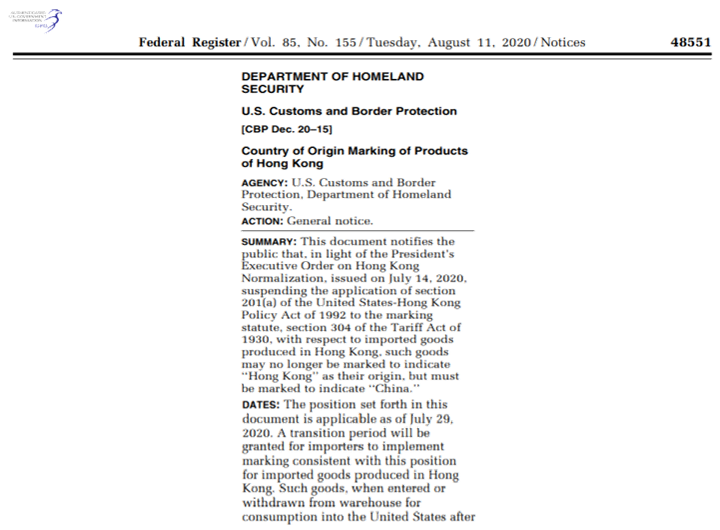
Full Federal Register Notice: https://www.govinfo.gov/content/pkg/FR-2020-08-11/pdf/2020-17599.pdf?utm_campaign=subscription+mailing+list&utm_source=federalregister.gov&utm_medium=email



CSMS #43511668 – Information on COBRA User Fee Changes Effective October 1, 2020
Pursuant to the General Notice (85 FR 45646) published July 29, 2020, various changes to user fees within the Consolidated Omnibus Budget Reconciliation Act (COBRA) of 1985 will take effect on October 1, 2020. The General Notice may be accessed at the link below:https://www.govinfo.gov/content/pkg/FR-2020-07-29/pdf/2020-16450.pdf
The Merchandise Processing Fee (MPF) ad valorem rate of 0.3464% will NOT change. The MPF minimum and maximum for formal entries (class code 499) will change. The minimum will change from $26.79 to $27.23; and the maximum will change from $519.76 to $528.33.
The fee for informal entry or release (class code 311) will change to $2.18.
The surcharge for manual entry or release will change to $3.27.
The dutiable mail fee (class code 496) will change to $5.99.
Another CSMS will be sent when the changes are in the ACE Certification environment for trade testing.


Update to United States Mexico Canada Agreement
After 25 year, the old North American Trade Agreement will be replaced tomorrow July 1, 2020. Each participating country has its own name, yet all three names refer to the same trade agreement. Please see the name for each country listed below.
- United States-Mexico-Canada Agreement (USMCA), in the United States
- Tratado entre Mexico, Estados Unidos y Canada (T-MEC), in Mexico.
- Canada-United States-Mexico Agreement (CUSMA), in Canada.
US Customs and Border Patrol issued a cargo systems messaging service with the final instructions. Please see CMSM# 43215543 US-Mexico-Canada Agreements (USMCA) Implementing Instructions (Final) – July 30, 2020. The CSMA published by Customs lists the website were you can find specific information for importing under USMCA. BOC will provide a Certificate of Origin that contains all the data elements that are required for USMCA, T-MEC and CUMA with instructions, to any party requesting it.
Cargo Systems Messaging Service CSMS #43215543
US-Mexico-Canada Agreement (USMCA) Implementing Instructions (Final) – June 30, 2020
This message is to inform the Trade Community of the release of the USMCA Implementing Instructions (Final) on June 30, 2020. The link to this document is available below.
These USMCA Implementing Instructions replace the Updated USMCA Interim Implementing Instructions issued on June 16, 2020, and provide guidance on the new requirements under the USMCA, including information on USMCA entry, compliance, rules-of-origin, origin certifications, new auto requirements, textile requirements, and other requirements for claiming USMCA preferential treatment for goods.
The supporting USMCA regulations, the new Part 182 of Title 19, Code of Federal Regulations (19 CFR 182) that includes the USMCA Uniform Regulations, will be issued on July 1, 2020. Additionally, the Harmonized Tariff Schedule of the United States will be amended effective, July1, 2020 to include General Note 11 (GN11) with information on the USMCA rules of origin, product specific rules, and other requirements.
Effective July1, 2020, the North American Free Trade Agreement (NAFTA) terminates and the USMCA enters into force.
Questions regarding this guidance can be directed to Maya Kamar, Director, Textiles and Trade Agreements Division at (202) 945-7228 or email FTA@CBP.DHS.GOV.
Questions regarding the USMCA automotive certification submission process for Labor Value Content certification, Steel certification, and Aluminum certification can be directed to the USMCA Center email at USMCA@CBP.DHS.GOV.
The USMCA Implementing Instructions – June 30, 2020
https://www.cbp.gov/document/guidance/usmca-implementation-instructions
The USMCA Implementation Act (Public Law No: 116-113)
https://www.congress.gov/bill/116th-congress/house-bill/5430/text
The USMCA Agreement, Final Text
USTR Federal Register Notice on USMCA Alternative Staging Regimes for Automotive Imports – 85 FRN 22238, April 21, 2020
https://www.govinfo.gov/content/pkg/FR-2020-04-21/pdf/2020-08405.pdf
CSMS #43197567 – USMCA Post-Importation Claims and MPF Processing
https://content.govdelivery.com/bulletins/gd/USDHSCBP-293247f?wgt_ref=USDHSCBP_WIDGET_2