………………………………………………………………………………………………………………………………………………………………………………………………………………………………………….
Importer Security Filing Facts and Details
………………………………………………………………………………………………………………………………………………………………………………………………………………………………………….
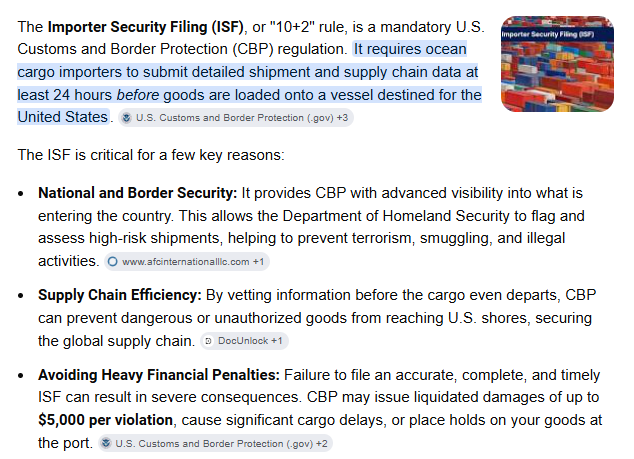
ISF (Importer Security Filing) is just as important as ever!
https://www.cbp.gov/border-security/ports-entry/cargo-security/importer-security-filing-102
Key points:
- ISF must be filed prior to departure of the vessel at origin.
- Importer of Record is the party responsible for providing and filing the required information, and the party CBP assesses penalties to for late, incorrect or incomplete ISF filing.
What is an Importer Security Filing?
Before merchandise arriving by vessel can be imported into the United States, the “Importer Security Filing (ISF) Importer,” or their agent (e.g., licensed customs broker), must electronically submit certain advance cargo information to CBP in the form of an Importer Security Filing.
This requirement only applies to cargo arriving in the United States by ocean vessel; it does not apply to cargo arriving by other modes of transportation.
Information required to be submitted includes Seller name, Buyer name, Importer of Record, Consignee name, Manufacturer (or Supplier), Ship to party, Country of origin of the product, HTS number, Container stuffing location and Consolidator
Who is Responsible for the Filing?
The ISF Importer (the US Importer of Record) (or their agent) is required to submit the Importer Security Filing. The ISF Importer is the party causing the goods to arrive within the limits of a port in the United States by vessel. Typically, the ISF Importer is the goods’ owner, purchaser, consignee, or agent
such as a licensed customs broker.
Where does the information come from?
The ISF is a ‘partnership’ between Shippers, Forwarders, Consolidators and Importers. Different information is supplied by different parties. But at the end of the day, the Importer is the one ultimately responsible for providing the required data to US Customs.
Importers either need to provide their US Customs broker with all the data to file ISF, or they need to rely on their shippers to provide the information to the US Customs broker. But the US Importer is still responsible.
Penalties
CBP may issue liquidated damages of $5,000 per violation for the submission of an inaccurate, incomplete or untimely filing.
If goods for which an ISF has not been filed arrive in the U.S.:
- CBP may withhold the release or transfer of the cargo;
- CBP may refuse to grant a permit to unlade for the merchandise; and if such cargo is unladen without permission, it may be subject to seizure.
Additionally, noncompliant cargo could be subject to “do not load” orders at origin or further inspection on arrival.
………………………………………………………………………………………………………………………………………………………………………………………………………………………………………….